3.2 Instantaneous Velocity and Speed
Learning Objectives
By the end of this section, you will be able to:
- Explain the difference between average velocity and instantaneous velocity.
- Describe the difference between velocity and speed.
- Calculate the instantaneous velocity given the mathematical equation for the position.
- Calculate the speed given the instantaneous velocity.
We have now seen how to calculate the average velocity between two positions. However, since objects in the real world move continuously through space and time, we would like to find the velocity of an object at any single point. We can find the velocity of the object anywhere along its path by using some fundamental principles of calculus. This section gives us better insight into the physics of motion and will be useful in later chapters.
Instantaneous Velocity
The quantity that tells us how fast an object is moving anywhere along its path is the instantaneous velocity, usually called simply velocity. It is the average velocity between two points on the path in the limit that the time (and therefore the displacement) between the two events approaches zero. To illustrate this idea mathematically, we need to express position x as a continuous function of t denoted by x(t). The expression for the average velocity between two points using this notation is . To find the instantaneous velocity at any position, we let and . After inserting these expressions into the equation for the average velocity and taking the limit as , we find the expression for the instantaneous velocity:
Instantaneous Velocity
The instantaneous velocity of an object is the limit of the average velocity as the elapsed time approaches zero, or the derivative of x with respect to t:
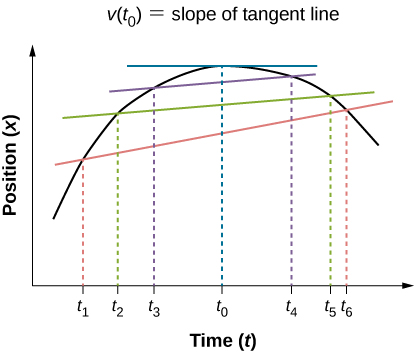
Like average velocity, instantaneous velocity is a vector with dimension of length per time. The instantaneous velocity at a specific time point is the rate of change of the position function, which is the slope of the position function at . Figure 3.6 shows how the average velocity between two times approaches the instantaneous velocity at The instantaneous velocity is shown at time , which happens to be at the maximum of the position function. The slope of the position graph is zero at this point, and thus the instantaneous velocity is zero. At other times, , and so on, the instantaneous velocity is not zero because the slope of the position graph would be positive or negative. If the position function had a minimum, the slope of the position graph would also be zero, giving an instantaneous velocity of zero there as well. Thus, the zeros of the velocity function give the minimum and maximum of the position function.
Example 3.2
Finding Velocity from a Position-Versus-Time Graph
Given the position-versus-time graph of Figure 3.7, find the velocity-versus-time graph.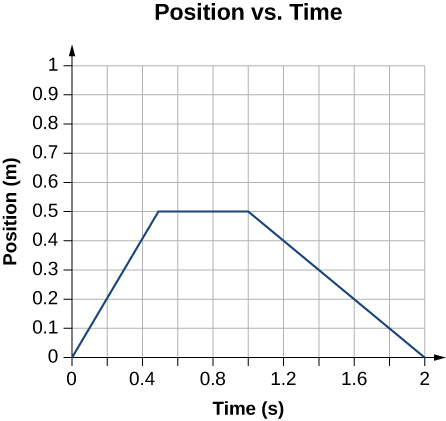
Strategy
The graph contains three straight lines during three time intervals. We find the velocity during each time interval by taking the slope of the line using the grid.Solution
Time interval 0 s to 0.5 s:Time interval 0.5 s to 1.0 s:
Time interval 1.0 s to 2.0 s:
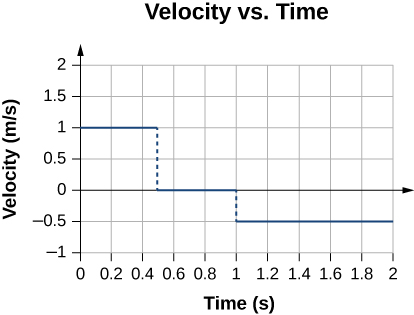
The graph of these values of velocity versus time is shown in Figure 3.8.
Significance
During the time interval between 0 s and 0.5 s, the object’s position is moving away from the origin and the position-versus-time curve has a positive slope. At any point along the curve during this time interval, we can find the instantaneous velocity by taking its slope, which is +1 m/s, as shown in Figure 3.8. In the subsequent time interval, between 0.5 s and 1.0 s, the position doesn’t change and we see the slope is zero. From 1.0 s to 2.0 s, the object is moving back toward the origin and the slope is −0.5 m/s. The object has reversed direction and has a negative velocity.Speed
In everyday language, most people use the terms speed and velocity interchangeably. In physics, however, they do not have the same meaning and are distinct concepts. One major difference is that speed has no direction; that is, speed is a scalar.
We can calculate the average speed by finding the total distance traveled divided by the elapsed time:
Average speed is not necessarily the same as the magnitude of the average velocity, which is found by dividing the magnitude of the total displacement by the elapsed time. For example, if a trip starts and ends at the same location, the total displacement is zero, and therefore the average velocity is zero. The average speed, however, is not zero, because the total distance traveled is greater than zero. If we take a road trip of 300 km and need to be at our destination at a certain time, then we would be interested in our average speed.
However, we can calculate the instantaneous speed from the magnitude of the instantaneous velocity:
If a particle is moving along the x-axis at +7.0 m/s and another particle is moving along the same axis at −7.0 m/s, they have different velocities, but both have the same speed of 7.0 m/s. Some typical speeds are shown in the following table.
| Speed | m/s | mi/h |
|---|---|---|
| Continental drift | ||
| Brisk walk | 1.7 | 3.9 |
| Cyclist | 4.4 | 10 |
| Sprint runner | 12.2 | 27 |
| Rural speed limit | 24.6 | 56 |
| Official land speed record | 341.1 | 763 |
| Speed of sound at sea level | 343 | 768 |
| Space shuttle on reentry | 7800 | 17,500 |
| Escape velocity of Earth* | 11,200 | 25,000 |
| Orbital speed of Earth around the Sun | 29,783 | 66,623 |
| Speed of light in a vacuum | 299,792,458 | 670,616,629 |
Calculating Instantaneous Velocity
When calculating instantaneous velocity, we need to specify the explicit form of the position function . If each term in the equation has the form of where is a constant and is an integer, this can be differentiated using the power rule to be:
Note that if there are additional terms added together, this power rule of differentiation can be done multiple times and the solution is the sum of those terms. The following example illustrates the use of Equation 3.7.
Example 3.3
Instantaneous Velocity Versus Average Velocity
The position of a particle is given by .- Using Equation 3.4 and Equation 3.7, find the instantaneous velocity at s.
- Calculate the average velocity between 1.0 s and 3.0 s.
Strategy
Equation 3.4 gives the instantaneous velocity of the particle as the derivative of the position function. Looking at the form of the position function given, we see that it is a polynomial in t. Therefore, we can use Equation 3.7, the power rule from calculus, to find the solution. We use Equation 3.6 to calculate the average velocity of the particle.Solution
- .
Substituting t = 2.0 s into this equation gives . - To determine the average velocity of the particle between 1.0 s and 3.0 s, we calculate the values of x(1.0 s) and x(3.0 s):
Then the average velocity is
Significance
In the limit that the time interval used to calculate goes to zero, the value obtained for converges to the value of v.Example 3.4
Instantaneous Velocity Versus Speed
Consider the motion of a particle in which the position is .- What is the instantaneous velocity at t = 0.25 s, t = 0.50 s, and t = 1.0 s?
- What is the speed of the particle at these times?
Strategy
The instantaneous velocity is the derivative of the position function and the speed is the magnitude of the instantaneous velocity. We use Equation 3.4 and Equation 3.7 to solve for instantaneous velocity.Solution
Significance
The velocity of the particle gives us direction information, indicating the particle is moving to the left (west) or right (east). The speed gives the magnitude of the velocity. By graphing the position, velocity, and speed as functions of time, we can understand these concepts visually Figure 3.9. In (a), the graph shows the particle moving in the positive direction until t = 0.5 s, when it reverses direction. The reversal of direction can also be seen in (b) at 0.5 s where the velocity is zero and then turns negative. At 1.0 s it is back at the origin where it started. The particle’s velocity at 1.0 s in (b) is negative, because it is traveling in the negative direction. But in (c), however, its speed is positive and remains positive throughout the travel time. We can also interpret velocity as the slope of the position-versus-time graph. The slope of x(t) is decreasing toward zero, becoming zero at 0.5 s and increasingly negative thereafter. This analysis of comparing the graphs of position, velocity, and speed helps catch errors in calculations. The graphs must be consistent with each other and help interpret the calculations.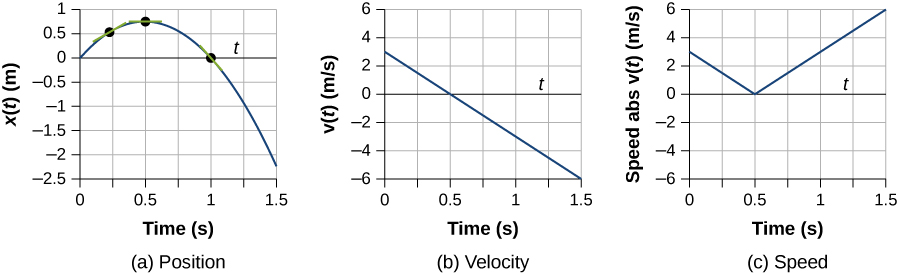
Numerical Method Example
Instantaneous Velocity For Any Function
We will now demonstrate a more advanced numerical method in Python. In the last section we introduced Python functions as a way to represent mathematical functions. Now let's use functions to explore instantaneous velocity. Sometimes the function that models the position of a particle is difficult to differentiate by hand. Consider the particle whose position is given by . We might not know how to do the derivative by hand yet, but we can use Python to make a plot of the derivative.
Recall the definition of the derivative given by In Python we can't take the limit as goes to zero, but we can make very small. Notice how in the code below we use a very small to define the function for velocity. Defining a function for position earlier makes the code look just like the definition of the derivative. In the code below, the definition of the derivative used to define a new function for velocity. Notice that this function calls the position function that we define earlier.
Notice how the definition of the derivative can be found in how we calculated . Let's see what the velocity versus time graph looks like. Below is a code that plots both the position versus time and velocity versus time side by side.
Does the result make sense to you? The places where the velocity graph goes through x axis should match the times where the positive vs time graph was at a maximum or minimum. In other words, the slope of the tangent line to the position vs time graph should be zero where the velocity vs time graph goes through the x axis.
Trying using this code to answer the question in Example 3.4.
We should give a note about this. Using Python we were able to calculate the derivative of . However, we did not obtain a symbolic answer; we only obtained a numerical answer. The numerical answer can be plotted or used to find the derivative at a specific time, but it can not be written as a mathematical equation. This can be a powerful tool in many problems, but is often used when the symbolic derivative is either impossible or would be too difficult to obtain by hand.
Check Your Understanding 3.2
The position of an object as a function of time is . (a) What is the velocity of the object as a function of time? (b) Is the velocity ever positive? (c) What are the velocity and speed at t = 1.0 s?